
The Challenge: When Roles Become the Problem
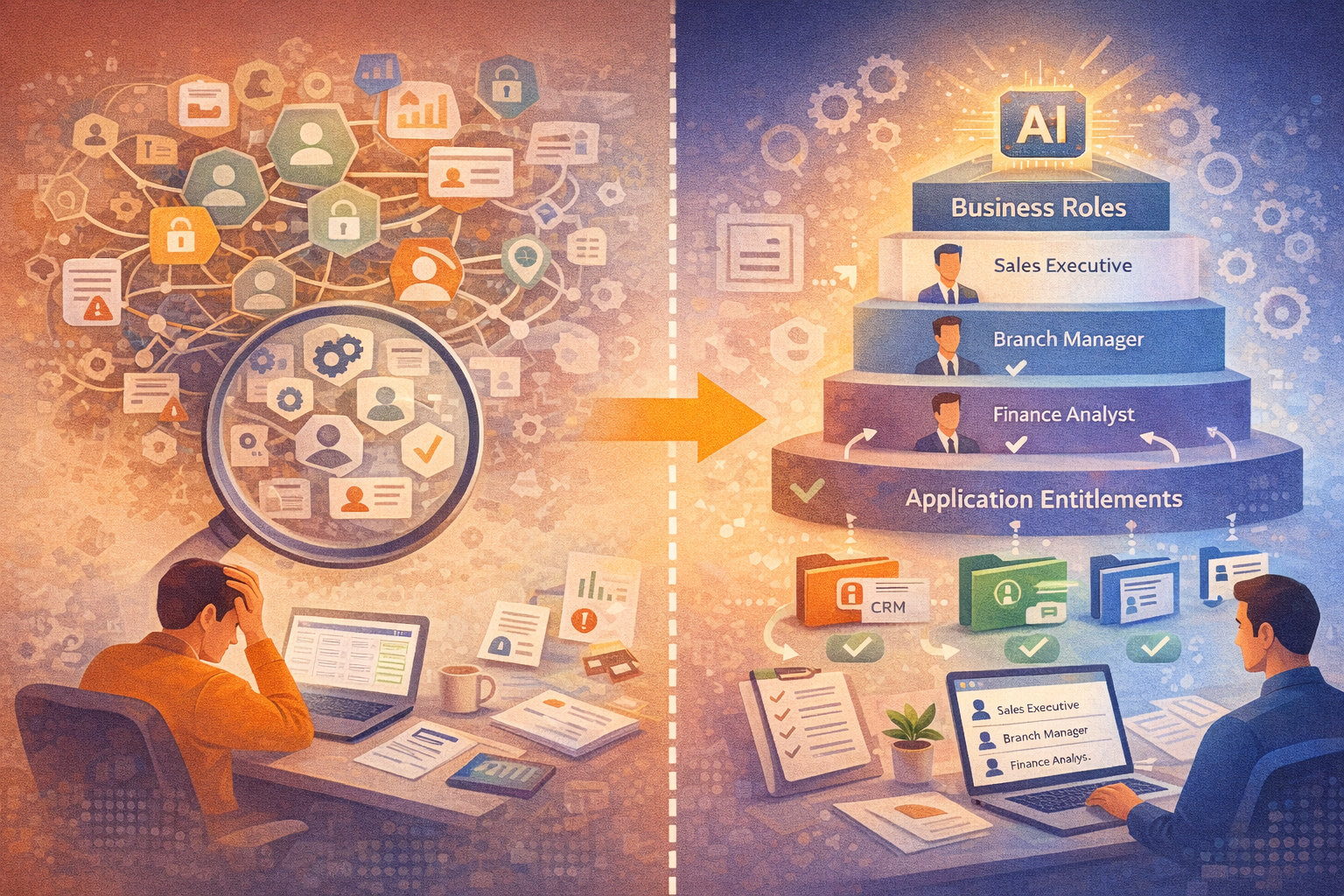
As organizations scale, identity governance often runs into a familiar but complex problem — role explosion.
One of our customers, a large enterprise with multiple business units and dozens of applications, faced exactly this situation. Over time, access had been provisioned in a largely application-centric manner, leading to:
- Hundreds of application-specific roles, each managed in isolation
- No clear mapping between business functions and system access
- Frequent over-provisioning or under-provisioning of access
- Heavy reliance on manual intervention for role assignments
- Difficulty in performing access reviews and audits
Their challenge was simple to describe, but difficult to solve:
“We don’t just need access management — we need a structured way to define and manage roles across the organization, and map them accurately to applications.”
Without a clear role model, identity governance becomes reactive, inconsistent, and hard to scale.
What the Customer Needed
The organization outlined three key objectives:
- Standardize roles across the enterprise — aligned to how the business actually operates
- Map roles to application entitlements in a structured and maintainable way
- Reduce manual effort in role creation, mapping, and ongoing maintenance
At the same time, they wanted to avoid a long, consulting-heavy role engineering exercise that could take months.
How BAAR-IGA Solved It
BAAR-IGA approached this by introducing a structured, layered role model, combined with AI-driven role mining and recommendations.
1. Separating Business Roles and Functional Roles
These represent job functions within the organization:
- Sales Executive
- Branch Manager
- Finance Analyst
Business roles are owned by the business, easy to understand, and stable over time.
These represent application-level access and entitlements:
- CRM_Read_Write
- Finance_System_Approver
- Reporting_Access_Level_2
Functional roles are mapped directly to application permissions.
2. Establishing a Clear Role Hierarchy
Once defined, BAAR-IGA created relationships between these layers:
- Business Roles → mapped to → Functional Roles
- Functional Roles → mapped to → Application Entitlements
This resulted in a clean, scalable structure:
User → Business Role → Functional Role → Application Access
Now, instead of assigning access application-by-application, access could be provisioned through roles, dramatically simplifying operations.
3. AI-Driven Role Mining and Recommendations
This is where BAAR-IGA delivered significant acceleration.
Instead of building roles manually, the platform’s AI engine analyzed:
- HR data (job titles, departments, reporting structures)
- Current user-to-application role mappings
- Access patterns across similar users
Based on this, BAAR-IGA:
- Identified common access clusters across users
- Proposed candidate functional roles
- Suggested business role groupings aligned with real-world usage
- Highlighted outliers and excessive access
This reduced what is traditionally a months-long role engineering exercise into weeks.
4. Continuous Optimization and Governance
Role management didn’t stop at creation.
BAAR-IGA enabled:
- Ongoing role refinement based on changing access patterns
- Integration with User Access Reviews (UARs) for validation
- Policy enforcement to prevent role sprawl
- Audit-ready reporting for role assignments and mappings
This ensured that the role model remained accurate, relevant, and compliant over time.
The Outcome
- Clear separation between business roles and application access
- Significant reduction in manual role management effort
- Accurate and consistent user-to-access mapping
- Reduced over-provisioning and access risks
- Faster onboarding and role assignment
- Improved auditability and compliance posture
Why This Matters
- Access becomes inconsistent
- Reviews become meaningless
- Compliance becomes difficult
- Access becomes predictable
- Governance becomes scalable
- Security becomes proactive
Final Thought
Role engineering doesn’t have to be slow, manual, or complex.
With BAAR-IGA’s structured role model and AI-driven insights, organizations can transform role management from a bottleneck into a strategic advantage.
From role chaos to role clarity — powered by intelligence.
